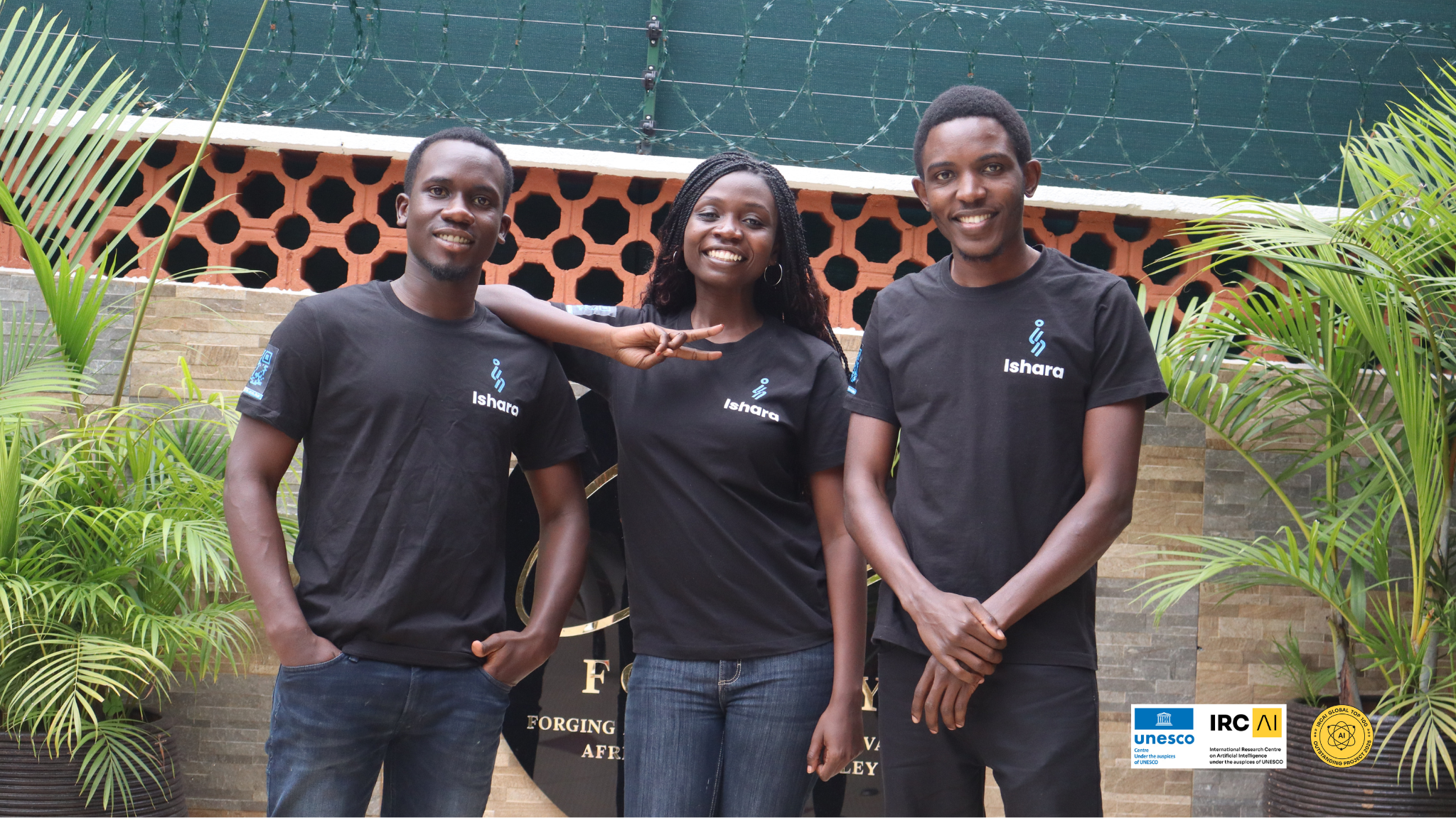
With breakthroughs in AI, we have an opportunity to significantly improve the lives of people with disabilities and create more inclusive societies. Among the most promising and socially impactful applications of AI are assistive technologies, which enhance communication, learning and social participation for people with disabilities. This year’s IRCAI Global Top 100 features at least five such AI-enabled assistive technologies. One of them is Ishara, a startup from Nairobi that has built a sign language translation platform, helping people with hearing loss access healthcare, education and the digital economy. Applying to the Top 100 for the first time, Ishara was immediately recognized as an Outstanding project. In this article, we take a closer look at their tool and why it matters.
When silence becomes a barrier: the hidden cost of exclusion
In Kenya, there is a Deaf community of over 3 million people, yet access to inclusive communication tools remains very limited. People with hearing loss most often encounter structural, social and technological barriers that constrain their autonomy and limit their participation in society. A survey conducted by the Ishara team found that every Deaf respondent had avoided a hospital at least once due to anticipated communication difficulties. The healthcare facilities lack professional interpreters, resulting in improvised communication with health workers. The majority of Deaf patients reported barely understanding their diagnoses, while medical workers reported longer consultations, frequent misunderstandings and increased clinical risk. Beyond healthcare, the same barriers constrain access to education, employment and digital participation.
“True innovation in this space must begin not with code, but with understanding of the lived experience.” Ishara’s team
Ishara as a communication bridge: AI-enabled sign language translation in real time
Ishara integrates sign language solutions into platforms people already use (such as smartphones), making accessibility effortless, affordable and available. The platform combines computer vision, natural language processing and 3D avatar animation to translate in real time between Kenyan sign language, text and speech in both directions. A dedicated learning module teaches Kenyan sign language to both Deaf and people with hearing loss. They have also integrated healthcare-focused translation datasets to improve accessibility of healthcare services. Ishara’s team is proud to create an innovation for a low-resource language through a human-centred approach, involving the Deaf community in testing and product design to ensure linguistic accuracy and cultural integrity.
Technology for inclusion is technology for progress
Ishara directly contributes to multiple SDGs, particularly SDG 3 (Good Health and Well-Being), SDG 4 (Quality Education) and SDG 10 (Reduced Inequalities). By bridging the communication gap in healthcare settings, it enhances accessibility for a population that has historically been excluded from basic medical care. It enables independent educational engagement for people with hearing disabilities, which are systematically underserved in today’s digital economy. The tools are accessible to the deaf individuals free of charge, built in a human-centered design approach together with the deaf community and adaptable to other African languages.
Opening doors: early results and road ahead
The platform has been tested with over 50 Deaf users in Kenya, receiving positive feedback on sign comprehension and healthcare use cases. Through partnerships with KNAD, Deaf Empowerment Kenya, AT4D and Kilimanjaro Blind Trust, models have evolved from basic fingerspelling to advanced phrase recognition. Their participation in Meta’s Llama Impact Accelerator has validated the platform’s potential to scale toward digital skills certification and job readiness for Deaf professionals. But what the Ishara’s team found most rewarding was seeing a Deaf learner follow educational content, ask questions and engage independently, without the need of any interpreter, for the first time.
Looking ahead, Ishara plans to scale across Kenya and Africa through partnerships with schools, hospitals and enterprises, keeping core tools free of charge for Deaf communities while open-sourcing models to enable replication across other African sign languages.
“We believe inclusive technology is not just important. it is the foundation of future human-centered innovation. As we build the future, let’s ensure it’s a future where no one is left behind.” Ishara’s team
For more information about Ishara, visit their website, connect on LinkedIn or Instagram (@ishara.ai), explore their open-source work on GitHub, or reach the team directly at hello at ishara.co.ke. Their Impact Inquiry Report on healthcare access for Deaf Kenyans is available here.
KEY FACTS
Project: Ishara
Website: ishara.co.ke
Description: AI-enabled translation platform helping deaf and hearing-impaired community in Kenya access healthcare, education services and bridge everyday communication gap.
Organization: Ishara AI Limited
Country: Kenya
Industry: Health, Education
Technology: LLaMa, Computer Vision, 3D Avatars, Natural Language Processing, Cloud infrastructure
SDGs: 3, 4, 10
Reach: Ishara is currently aiming to reach the deaf community of 3 million people in Kenya.
Stage: Deployed, commercially active
IRCAI recognized this project as Outstanding in the Top 100 2025, evaluated for AI integrity, SDG impact, business sustainability, and ethical design.