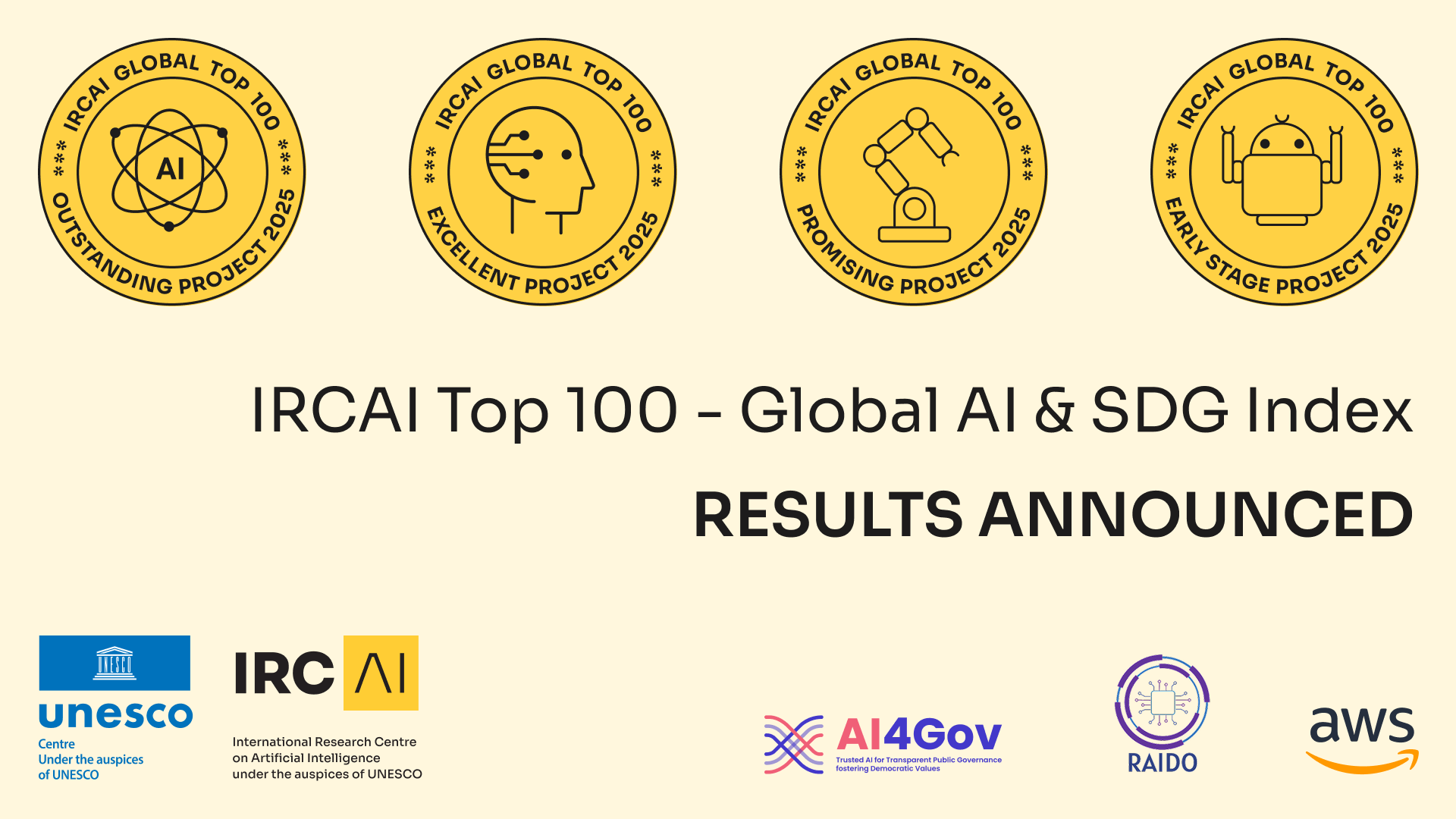
IRCAI proudly announces the Top 100 2025, a curated list of 100 responsible, scalable, and sustainable projects from around the world that leverage AI to deliver tangible solutions to some of the world’s most pressing challenges, outlined in the Sustainable Development Goals (SDGs).
The Top 100 2025 list is available here: https://ircai.org/global-top-100-outstanding-projects/results/
This year, participating applicants come from over 30 countries across all UN geographic regions: Africa, Europe, North America, Latin America, Asia and the Pacific, and Oceania. The 2025 call has proven that the use of AI in sustainability is thriving in research groups, startups, companies, non-profit organizations and public institutions. The AI innovations demonstrate higher project maturity, more advanced AI technologies, stronger integration of ethical and responsible AI practices, and clearer evidence of impact across all 17 SDGs. This year, we are expanding the scope of the programme by offering additional development and scaling opportunities to the highest-ranked projects with strong potential for further growth and real-world impact. The solutions listed are applicable and can credibly solve real development challenges.
Meet This Year’s Innovators
Outstanding Projects
CityRover AI (Canada) — AI-powered vehicle system that automates municipal infrastructure data collection, improving operational efficiency and reducing environmental impact for cities.
Child Growth Monitor (Germany) — AI smartphone app that detects child malnutrition through video analysis, delivering fast, low-cost nutrition assessments for children aged 6–59 months.
uLearn (Nigeria) — AI learning platform that generates curriculum-aligned STEM content in indigenous Nigerian languages, improving educational access and inclusion in local schools.
Cetus (Canada) — AI solution that detects and classifies whale populations using satellite imagery, enabling global monitoring and informed conservation decisions.
Valvur (Estonia) — Privacy-preserving edge AI tool that detects risky online behaviors and delivers gamified safety guidance, promoting digital well-being for children and families.
M-Situ (Kenya) — AI-powered IoT system that detects deforestation, wildfires, and illegal activities in real-time, enabling immediate conservation intervention.
ToumAI (Morocco) — Multilingual voice AI platform that enables inclusive access to digital and public services in underrepresented African languages and dialects.
Watchmen Platform (Germany) — AI manufacturing assistant that transforms machine signals into actionable insights, reducing downtime, energy waste, and CO₂ emissions.
Climate Policy Radar (UK) — AI platform that analyzes dense climate documents, supporting informed decision-making for policymakers, researchers, and advocates.
BioAutoML (Brazil) — Automated ML platform that enables non-experts to generate predictive models for biological sequences, democratizing AI in life sciences.
Briink (Germany) — AI platform that automates ESG reporting by extracting and benchmarking sustainability data from documents and websites.
Ishara AI (Kenya) — AI translation platform that bridges communication between Deaf and hearing communities through Kenyan Sign Language, text, and speech conversion.
Special Mentions
OpenProf (Slovenia) — Curriculum-aligned AI learning assistant that delivers step-by-step guidance and personalized feedback for students and educators in STEM subjects. (Oustanding category)
Zindi (United States) — Community-driven platform that connects over 90,000 learners in Africa and the Global South to AI career opportunities through data science challenges and training. (Oustanding category)
HumanAI (Spain) — AI tool that evaluates 35 socio-emotional competencies from text, providing bias-free insights for education, employability, and well-being. (Excellent category)
Aquascore (Morocco) — AI platform that ranks water criticality using multimodal data, guiding resource allocation decisions in water-stressed regions. (Excellent category)
Compar:IA (France) — AI platform that supports low-resourced languages while raising awareness of AI model plurality, cultural and linguistic bias, and environmental impact. (Promising category)
Monse (Slovakia) — AI monitoring system that detects routine anomalies in seniors’ daily activities, ensuring safety through real-time caregiver alerts. (Promising category)
Delia (Burkina Faso) — AI maternal health service that provides personalized guidance and triages health risks via SMS/WhatsApp, improving timely care access in Sub-Saharan Africa. (Early Stage category)
The Top 100, an AI & SDG global index, supports entrepreneurs, researchers, academics, and professionals in public agencies and social enterprises, especially those whose AI tools might not otherwise gain visibility in global markets or reach their full potential impact. The list includes outstanding, excellent, promising, and early-stage projects from all five continents, ensuring diverse voices are represented.
The reviewers looked for solutions that directly or indirectly solve sustainable development challenges, with a strong focus on AI, machine learning, and data science components. IRCAI made final decisions based on potential implementation and sustainability impact, as well as quality and maturity of scientific content, considering these criteria: robust AI component; clear, measurable SDG contributions; ethical and responsible AI practices; and implementation readiness with potential for tangible impact by the end of 2025.
Through the Top 100 platform, companies, organizations and individuals will have the opportunity to exchange knowledge, network and collaborate on shared goals across sustainable challenges in different regions. Solutions to the most important challenges of our time can be found in this network, which has the potential to transform into an ecosystem that supports the SDGs and continues to creates solutions for the benefit of everyone, worldwide.