Fourth edition of the global programme will support up to 10 startups using frontier AI and advanced computing to tackle climate and energy challenges, with extreme heat named a special area of interest for 2026
LJUBLJANA, Slovenia, September 18, 2026 — The International Research Centre on Artificial Intelligence (IRCAI), a UNESCO Category 2 Centre, and Amazon Web Services (AWS) today announced that applications are open for the 2026 Compute for Climate Fellowship, a global research and development programme supporting climate and energy technology startups using advanced cloud computing and artificial intelligence (AI) to develop new solutions to the climate crisis and accelerate the clean-energy transition.
Download the Press Release on AWS Compute for Climate Fellowship.
Now entering its fourth year, the Compute for Climate Fellowship will accept up to 10 startups from around the world and provide up to $2 million in grants in the form of AWS credits, with individual awards of up to $200,000 per startup to cover cloud computing costs associated with building a proof of concept (PoC). Selected companies will also receive approximately three months of personalized technical support and mentorship from AWS and IRCAI experts in advanced computing, AI, sustainability, science, and ethics.
Since its launch in 2023, the Fellowship has supported 35 startups across three cohorts, helping companies apply advanced computing to challenges ranging from fusion energy and distributed energy systems to biodiversity monitoring, circular manufacturing and climate-resilient agriculture.
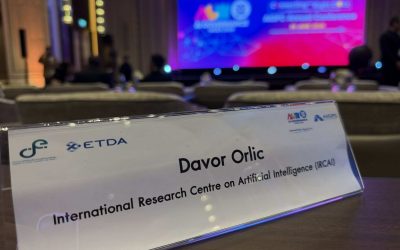
“Over the past three years, the Compute for Climate Fellowship has shown what becomes possible when ambitious climate innovators are given access not only to computing resources, but also to scientific expertise and responsible AI guidance,” said Davor Orlic, Chief Operating Officer of IRCAI. “For 2026, we are taking the programme further into frontier technologies—from scientific machine learning and digital twins to physical AI, advanced simulation and quantum approaches. At the same time, responsible and sustainable use of AI remains fundamental. We want to support solutions where advanced computing is truly essential to achieving climate impact, and where that impact can ultimately benefit communities around the world.”
The 2026 Fellowship reflects the rapidly evolving role of advanced computing in climate and energy innovation. The programme is particularly seeking proposals that make essential use of AI, machine learning, generative and agentic AI, physical AI and robotics, high-performance computing (HPC), physics-informed and scientific machine learning, Earth observation, digital twins, and quantum or quantum-inspired optimization.
“Many of the most promising climate technologies require enormous amounts of computation to move from an idea to something that can be tested in the real world,” said Alexandra Lucke, Venture Capital & Startups, EMEA Climate Tech at AWS. “The Compute for Climate Fellowship is designed to help founders overcome that barrier. By combining AWS cloud technologies and technical expertise with IRCAI’s scientific and responsible AI capabilities, we can help startups test ambitious ideas faster—from modelling future energy systems and discovering new materials to improving climate forecasting, autonomous systems and resilient infrastructure.”
Seven Climate and Energy Solution Areas for 2026
Successful proposals should demonstrate innovation, make essential use of advanced computing, and show potential for significant global impact in at least one of seven areas:
- Clean Energy, Grid Flexibility, and Fusion/Nuclear Simulation, including renewable-energy forecasting, energy storage, virtual power plants, grid digital twins, fusion and nuclear simulation, hydrogen systems and energy-market optimization.
- Climate Intelligence, Earth Observation, and Risk Analytics, including geospatial AI, climate and weather modelling, emissions measurement and verification, methane detection, climate-risk analysis and multi-hazard early-warning systems.
- Sustainable Agriculture, Food Systems, and Water Security, including precision agriculture, autonomous farming, alternative proteins, crop-risk prediction, drought resilience, water-treatment optimization and climate-smart supply chains.
- Circular Economy, Industrial Simulation, and Low-Carbon Materials, including low-carbon industrial processes, generative AI for materials discovery, manufacturing optimization, industrial digital twins, critical-minerals traceability and waste-to-value systems.
- Carbon Removal and Ecosystem Restoration, including direct air capture, enhanced weathering, biochar, blue carbon, automated measurement, reporting and verification, and monitoring of nature-based solutions.
- Low-Carbon Transportation, Logistics, and Autonomous Systems, including autonomous-vehicle simulation, EV battery modelling, charging infrastructure, fleet electrification, sustainable aviation and maritime solutions, and large-scale logistics optimization.
- Sustainable Built Environment and Data Centre Infrastructure, including data-centre cooling, energy and water efficiency, carbon-aware workload scheduling, waste-heat recovery, thermal digital twins, building-energy optimization and urban microclimate modelling.
Extreme Heat Named a Special Area of Interest
Against the backdrop of increasingly severe heatwaves worldwide, extreme heat is a special area of interest for the 2026 Fellowship. IRCAI and AWS particularly encourage proposals that use advanced computing and AI to anticipate heat risks, protect vulnerable populations, strengthen energy and infrastructure resilience, and support more effective adaptation to rising temperatures.
The Fellowship also maintains a cross-cutting priority for community-led and Indigenous-led approaches across all seven solution areas. Applicants are encouraged to combine advanced technologies with local knowledge, lived experience and culturally appropriate approaches to climate mitigation, adaptation and resilience.
Responsible AI and Sustainable Compute at the Core
For 2026, applicants are being asked to demonstrate not only what advanced computing can make possible, but why it is necessary for their proposed PoC. Proposals should demonstrate responsible AI practices including model efficiency, explainability, bias testing and sustainability-aware computing. PoCs will be developed in line with principles reflected in UNESCO’s Ethics Impact Assessment for Artificial Intelligence, reinforcing the programme’s commitment to safe and responsible technology development.
IRCAI was established as a Category 2 Centre under the auspices of UNESCO, with a global mandate to advance research and applications of AI in support of sustainable development. Its role in the Fellowship brings together scientific expertise, ethical AI principles and international networks alongside AWS cloud technologies and technical expertise.
From Climate Ideas to Working Proofs of Concept
Selected startups will receive AWS credits covering cloud computing costs of their PoCs, personalized mentorship, and access to advanced computing services including HPC, generative AI and quantum computing tools. Companies may also receive media and visibility opportunities and opportunities to showcase results through AWS channels, United Nations events and other international forums.
Previous Fellowship participants have applied these resources to a diverse range of climate challenges. Realta Fusion in the United States has used cloud-based simulation to advance magnetic confinement fusion research; France-based Cosma has used autonomous underwater drones and AI to map marine ecosystems; Phytoform Labs in the United Kingdom has developed AI approaches for climate-resilient crop genetics; and Hum.AI in Canada has worked with First Nations communities on AI-powered approaches to ecosystem monitoring and restoration.
The Fellowship is open globally to privately held climate and energy technology companies founded within the past 10 years, generally up to Series A stage, with technical teams capable of building a PoC using advanced cloud computing and AI or machine learning. Selected startups remain responsible for building their own PoCs, supported by scientific mentors from IRCAI and technical experts from AWS, and retain ownership of the intellectual property resulting from their projects.
Applications are open September 1–30, 2026. Review and finalist interviews will take place during October and November, with winners scheduled to be announced on December 4, 2026. Selected startups will develop their PoCs from January 11 through April 5, 2027, followed by a Demo Day on April 14, 2027.
Startups that apply but are not selected may also be eligible for up to $5,000 in AWS Activate credits, subject to eligibility requirements.
Applications and full eligibility information are available on the IRCAI 2026 Compute for Climate Fellowship programme page.
About the International Research Centre on Artificial Intelligence (IRCAI)
The International Research Centre on Artificial Intelligence (IRCAI) is a Category 2 Centre under the auspices of UNESCO based in Ljubljana, Slovenia. IRCAI advances artificial intelligence research and applications in support of the United Nations Sustainable Development Goals, bringing together researchers, institutions, governments, industry and other stakeholders from across the world. Its work places particular emphasis on responsible, ethical, inclusive and sustainable AI and on ensuring that the benefits of artificial intelligence serve society.
Media Contact
Anja Polajnar
International Research Centre on Artificial Intelligence (IRCAI)
info@ircai.org
Ljubljana, Slovenia