
TWO UNESCO Workshops on the Ethics of AI
A capacity-building initiative supporting the UNESCO – LG AI Research Global MOOC on the Ethics of AI
9 – 10 December 2026, Poljanski nasip 2 (Faculty of Law) and Trubarjeva 72 (Center Rog), Ljubljana
Attendance is free, but registration is required.
DAY 1 - Workshop 1: Fairness, Non-discrimination and Inclusion
Registration: TBA
Date: 9. 12. 2026
Time: 10:00 – 14:00 CET
Location: Poljanski nasip 2 (Faculty of Law), Ljubljana
The workshop explores how public administrations (and others) can use AI to support decisions and deliver services that work for everyone. Participants ask who benefits, who risks being excluded or disadvantaged, who decides, and who identifies and addresses errors. Using a public-service case, groups explore how AI-supported decisions and citizen-facing tools can affect different people, from initial deployment to changes in how the system is used and the degree of automation.
Working groups will write a one-page fairness plan: who owns the system, what is checked, when it is paused or stopped, what stays for people who cannot use it, and who decides on more automation. In an audit, groups swap plans and test them in seven steps, from scope to follow-up. They post what works and what is missing on a shared wall frame. The workshop produces a fairness audit frame.
PRELIMINARY AGENDA
10:00-10:10 Welcome
UNESCO and AI ethics in brief; how the day works
10:10-10:30 MOOC grounding
Walkthrough of the fairness module: key concepts and safeguards
10:30-11:10 Panel Discussion
Theme: “Making fairness and inclusion work when public-facing services use AI.”
11:25-11:40 Case set-up
11:40-12:20 Exercise A: What goes wrong
Groups trace who gets worse service at each step of the case, who decides, and who catches the error
12:20-12:50 Exercise B: The fairness plan
Groups write a one-page plan for the assistant
12:50-13:20 Exercise C: The audit
Groups swap plans and audit them in seven steps, then post notes on the wall frame
13:35-13:50 Moderated conversation
Experts react to the wall frame: which gap matters most, and who should close it
13:50-14:00 Wrap
Circle the rows with the most gaps; link back to the MOOC; capture outputs
DAY 2 - Workshop 2: Global AI Governance
Registration: TBA
Date: 10. 12. 2026
Time: 10:00 – 14:00 CET
Location: Trubarjeva 72 (Center Rog), Ljubljana
Participants work through one case: a deepfake video of a candidate released a week before an election. The AI company is in one country, the platform in a second and the voters in a third. Groups study real laws, standards and voluntary codes, find the seams where something is lost or no one can act, and choose the instrument and the fix for each. In a peer audit, each group then takes the role of a stakeholder, such as the platform, the election authority or the fact-checkers. It weighs the advantages and disadvantages of other groups’ fixes from that seat. The day produces a map of the gaps in global governance.
PRELIMINARY AGENDA
10:00-10:10 Welcome
UNESCO and AI ethics in brief; how the day works
10:10-10:30 MOOC grounding
Quick walkthrough of the global governance module (key tensions, with a focus on sovereignty and interoperability, and how they apply)
10:30-11:10 Panel Discussion
Theme: “Governing AI across borders: from shared principles to workable rules.”
11:25-11:40 Case set-up
One case, the same for all groups: a deepfake video of a candidate a week before an election. The AI company is in Country A, the platform in Country B and the voters in Country C.
11:40-12:30 Exercise A: Mind the seams
Groups study eight real instruments and trace the video across the borders. They mark the seams where something is lost or no one can act. For each seam they choose an instrument and write the fix and why it works.
12:30-13:20 Exercise B: The peer audit
Each group draws a role (AI company, platform, election authority, fact-checkers or campaign) and audits two other groups’ seams, writing one advantage and one disadvantage per fix. Authors revise one fix. The room then marks the gaps.
13:20-13:45 Moderated conversation
Experts react to the scoreboard: which gap matters most, and who should close it
13:45-14:00 Wrap
Link back to the MOOC; capture and share outputs
Background
In recognition of rapidly developing AI technologies and their applications on human beings and societies, 193 Member States of UNESCO unanimously agreed to Recommendation on the Ethics of AI in 2021, the first ever global normative instrument in this area. The Recommendation is a policy-friendly blueprint to guide the development of AI technologies for the betterment of the world for us and future generations.
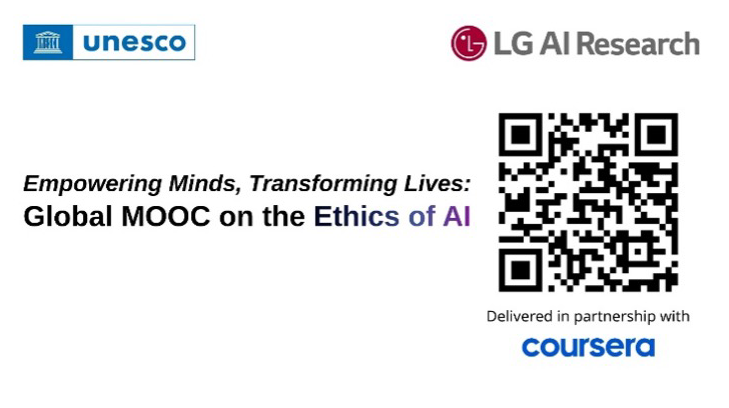
With this foundation, UNESCO and LG AI Research launched the Global MOOC on the Ethics of Artificial Intelligence on 20th July 2026. This MOOC is hosted on Coursera—freely accessible worldwide, available in 11 languages, and provides a certificate on completion. It is structured across ten modules covering fairness and inclusion, privacy and data governance, transparency and accountability, safety and security, environmental sustainability, and global AI governance. It is designed for technologists, researchers, policymakers, students, and any professional whose work touches AI, and it introduces an ethics-by-design approach applicable across the AI lifecycle.

The Workshops
This workshops builds on the MOOC, moving participants from awareness of the Recommendation’s principles to applied decision-making in the settings where AI systems are designed, deployed and governed. The MOOC offers asynchronous foundational learning at scale. The workshops adds facilitated group work, with one theme and one concrete case each day.
Both days follow the same pattern: a short background of the relevant MOOC module, a panel discussion, hands-on group work, and a moderated conversation in which experts react to what the groups produced.
Objectives
- Translate the transparency, accountability and governance principles of the UNESCO Recommendation on the Ethics of AI into decisions participants can make in their own work.
- Build practical skills in deciding what people need to know about an AI system, when they need to know it, and who answers for the outcome.
- Build the ability to read real governance instruments, such as laws, standards and voluntary codes, and to judge their strengths and gaps from different stakeholders’ standpoints.
Local Organizers
International Research Centre on Artificial Intelligence Under the Auspices of UNESCO (IRCAI) at Jožef Stefan Institute (JSI)
IRCAI advances the development and use of AI to support the UN Sustainable Development Goals. The Centre supports interdisciplinary research, bringing together technical expertise with insights from the social sciences, humanities, law and ethics to address AI’s societal implications. With a strong focus on ethical and responsible AI, IRCAI promotes research, international cooperation and capacity-building that help embed ethical considerations into the design, development and governance of AI systems. Connecting researchers, policymakers, industry and civil society, it supports the translation of ethical principles into evidence-informed policy and practice, in line with UNESCO’s Recommendation on the Ethics of Artificial Intelligence.

Department of International Law at Faculty of Law, University of Ljubljana (UL)
The Department of International Law brings together teaching, research and professional expertise in international law and global governance. Working closely with the Faculty’s Institute for International Law and International Relations, it contributes expertise in human rights, international organisations, state responsibility and the relationship between international and European Union law. Its members engage in research, expert advice and international academic dialogue, including on artificial intelligence and human rights, bringing a legal perspective to the challenges of governing emerging technologies across borders.
Format
Audience: 25-30 participants, drawn from a mixed cohort of students, researchers, professionals and experts, working in groups.
Duration: 2 half days, 10:00–14:00 (with coffee breaks provided).
Delivery and language: Interactive, in-person group exercise. English.
Prerequisite: Prior completion of Module 4 (Fairness, non-discrimination, and inclusion) and Module 10 (Global AI Governance) from the MOOC is encouraged, but not mandatory.
Supported by

CONTACT
International Research Centre
on Artificial Intelligence (IRCAI)
under the auspices of UNESCO
Jožef Stefan Institute
Jamova cesta 39
SI-1000 Ljubljana
info@ircai.org
ircai.org
FOLLOW US
The designations employed and the presentation of material throughout this website do not imply the expression of any opinion whatsoever on the part of UNESCO concerning the legal status of any country, territory, city or area of its authorities, or concerning the delimitation of its frontiers or boundaries.
PRIVACY POLICY