Ljubljana, Slovenia — 16 October 2026
The first edition of the Artificial Intelligence Accelerating Sustainable Development Goals (AI4SDG) workshop has demonstrated the growing global interest in harnessing artificial intelligence (AI) for sustainable development. With over 40 submissions from 29 countries, spanning Brazil to Japan, AI4SDG brought together a diverse international community of researchers, innovators, policymakers and practitioners to explore how AI can contribute to the United Nations Sustainable Development Goals (SDGs), while addressing the ethical, environmental and societal challenges that accompany its rapid development.
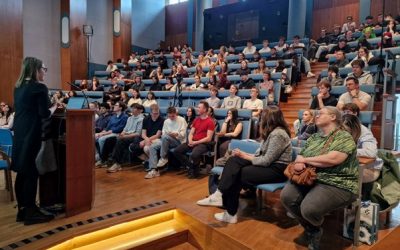
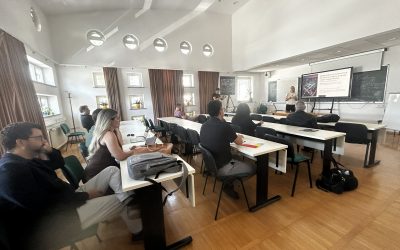
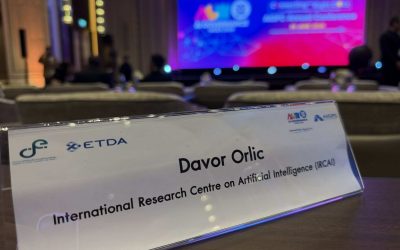
Held on 9 October 2026 at the Jožef Stefan Institute in Ljubljana, Slovenia, alongside the 29th International Multiconference Information Society – IS 2026, the hybrid workshop was organised by the International Research Centre on Artificial Intelligence under the auspices of UNESCO (IRCAI), in cooperation with the Center for Artificial Intelligence and Machine Learning (CIAAM) at the University of São Paulo, extending the UNESCO Centre CETIC to the AI discussions, the International Centre for Artificial Intelligence Research and Ethics (ICAIRE) that this year hosted the UNESCO Global Forum on the Ethics of AI, and the Electronic Transactions Development Agency (ETDA) in Thailand forthcoming to the UNESCO AI Centres family. It took place with the support of the NAIXUS Network for Artificial Intelligence, Knowledge and Sustainable Development and the European Lighthouse of AI for Sustainability (ELIAS).
From a global initiative to a shared research agenda
In times of uncertainty surrounding AI, AI4SDG represents a celebration of the breadth and diversity of research and innovation activities emerging across the international AI-for-sustainability community. The workshop builds on a series of initiatives developed by IRCAI and its partners since 2024 through NAIXUS, ELIAS, AI in Africa and GITEX, creating opportunities for researchers, entrepreneurs, young innovators and policymakers to connect technological advances with real-world sustainable development challenges.
AI4SDG builds on this experience by providing a platform where different disciplines, geographical perspectives and approaches to responsible AI can meet. The response to the 2026 call for contributions, with submissions from 29 countries, illustrates the international reach of this agenda and the importance of strengthening collaboration across regions, particularly by ensuring that expertise and priorities from the Global South are represented in global discussions about AI.
The programme brought together contributions from universities, research institutes, public institutions and international organisations, reflecting the increasingly interconnected nature of AI research, public policy, education, infrastructure and sustainable development.
A broad research agenda: from climate resilience to responsible AI
The discussions and presentations at AI4SDG 2026 highlighted an important shift in the AI-for-sustainability debate: moving beyond the question of what AI can technically achieve towards examining how it can deliver meaningful, equitable and measurable benefits for people and the planet.
Climate action, disaster-risk reduction and environmental sustainability formed one of the central themes. Contributions explored how bibliometric analysis can map AI research on climate resilience, how retrieval-augmented generation can support comparisons of national climate commitments, and how online data can provide signals for monitoring climate hazards and informing SDG 13 indicators. Research on urban flood-risk mapping also demonstrated the potential of machine learning and geospatial data to support climate-resilient planning, including in data-scarce regions. Together, these approaches point towards more responsive, evidence-based systems for anticipating environmental risks and supporting decision-making.
A second major theme concerned AI governance, ethics and accountability. Researchers examined sustainability-by-design in AI governance protocols, the gap between public algorithm registers and the practical governance of deployed systems, and the potential of AI-powered policy intelligence to support the analysis of global AI governance developments. Other contributions considered digital-space resilience and the challenges posed by malicious actors. These discussions reinforced the need to connect principles and policy frameworks with implementation, transparency and accountability in real-world AI systems.
The workshop also addressed the environmental footprint and strategic infrastructure of AI itself. Discussions of the emerging AI power crisis raised questions about the relationship between the expansion of AI capabilities and growing energy demands. Contributions on sustainable AI infrastructure, data centres, international data transfers and digital sovereignty highlighted the importance of developing AI ecosystems that are not only technologically capable but also environmentally responsible, resilient and aligned with local and regional priorities.
Education, AI literacy and inclusive learning provided another important strand of the programme. Presentations examined AI literacy in marginalised educational communities, children’s rights in educational chatbot interactions, governance frameworks for AI in primary education, teachers’ experiences of inclusive classrooms and national readiness for AI in Brazilian schools. The programme also explored the integration of Indigenous knowledge into digital learning environments and the role of generative AI in preparing students for future skills and lifelong learning. Collectively, these contributions emphasised that the benefits of AI in education depend on more than access to technology: they require appropriate governance, teacher development, inclusion, cultural sensitivity and protection of learners’ rights.
Beyond these themes, AI4SDG showcased research on smart cities, social innovation and sustainable economic development. Work on privacy-preserving federated causal inference explored ways of supporting sustainable urban systems while protecting sensitive data. Research on collaborative urban design investigated how machine learning could support participatory planning, while contributions on AI-enabled knowledge infrastructures considered the business value, adoption and governance of technologies for social innovation. The programme also examined the relationship between AI, workforce capabilities and sustainability in tourism distribution.
An important common thread across these topics was the need to evaluate AI not simply through technical performance, but through its wider social, environmental and institutional consequences. Responsible deployment requires attention to who benefits, who may be excluded, how systems are governed, and whether the solutions being developed respond to the needs of the communities they are intended to serve.
Building bridges across regions and institutions
International collaboration was a defining feature of the AI4SDG story. The workshop connected European research and innovation with perspectives and expertise from Latin America, Africa, Asia and other regions, reflecting IRCAI’s commitment to building a genuinely global community around AI for sustainable development.
The programme included research linked to the international AI research landscape and the collaborative activities developed through NAIXUS and ELIAS, alongside initiatives connected to the GITEX AI4SDG programme. This broader ecosystem helps create pathways between academic research, practical experimentation, entrepreneurship, capacity building and policy engagement.
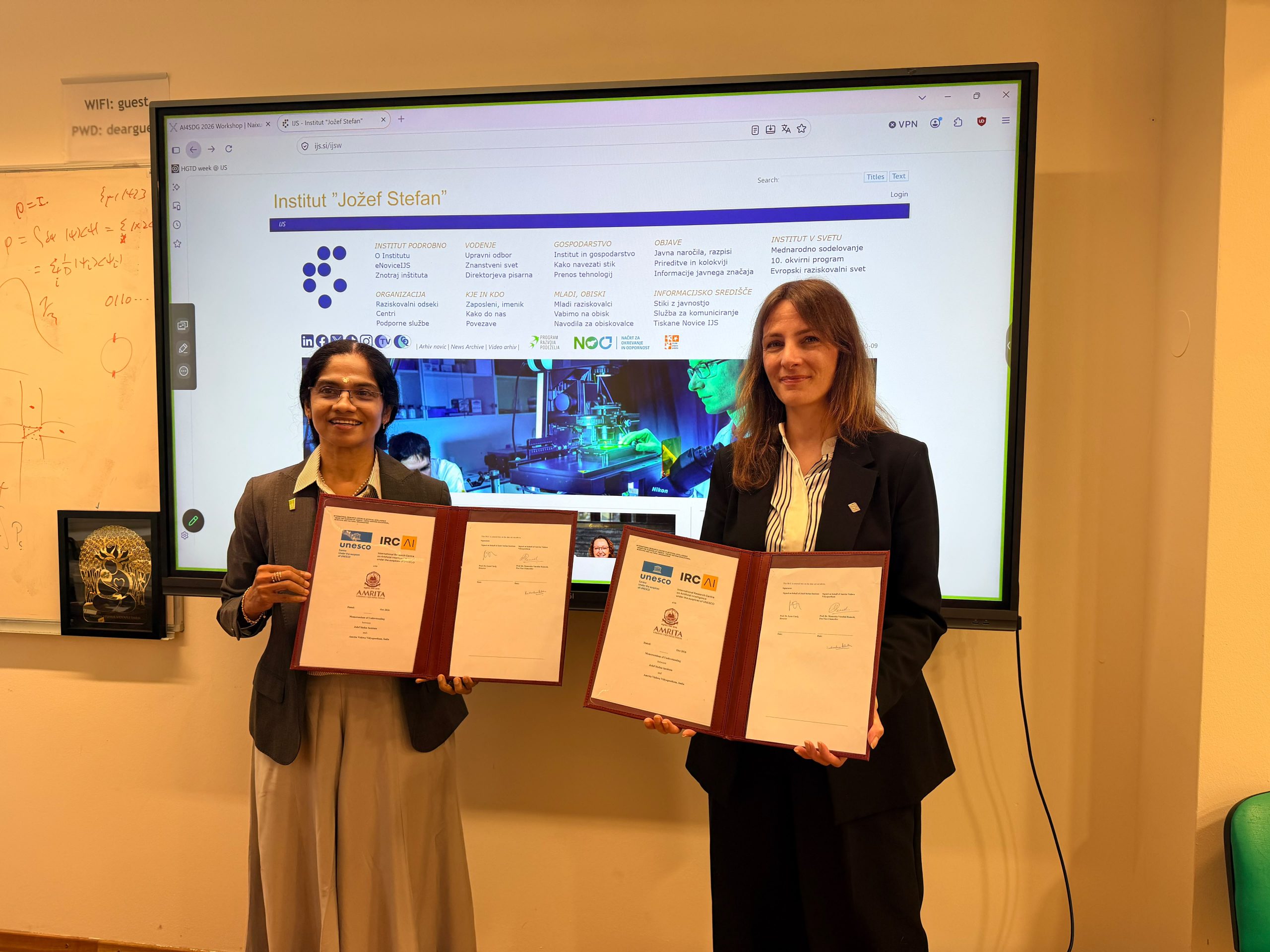
The event also highlighted the importance of collaboration between AI research centres and public institutions. A memorandum of understanding between IRCAI and Amrita Science Institute marked a further step towards strengthening international research cooperation. Contributions from partners working on AI governance, education, climate resilience and sustainable infrastructure demonstrated the value of connecting different forms of expertise to address challenges that cannot be solved by any single institution or country.
The workshop’s hybrid format further supported this international exchange, enabling participation beyond Ljubljana and extending the conversation across geographical boundaries.
From research to action: advancing the SDGs through responsible AI
AI4SDG 2026 also reinforced the importance of translating research findings into practical approaches, policy recommendations and collaborative initiatives. Whether through climate intelligence, more inclusive education, privacy-preserving urban analytics or more accountable AI governance, the contributions showed that AI for sustainable development is not one research field, but a meeting point for many disciplines and communities.
The programme concluded by looking towards further opportunities for collaboration and dissemination, including the Journal of Artificial Intelligence for Sustainable Development (JAISD) and a dedicated special collection connected to AI4SDG. These avenues will help extend the reach of the work presented and encourage continued dialogue between researchers and practitioners.
For IRCAI, AI4SDG is part of a wider mission to ensure that AI contributes to human well-being, environmental sustainability and the achievement of the SDGs. Its first edition confirms the value of bringing together different research traditions, regional experiences and stakeholder perspectives around a shared question: how can AI be developed and deployed in ways that genuinely serve sustainable development?
Looking ahead
The story of AI4SDG is ultimately a story of connection: between AI and the SDGs, research and implementation, technological innovation and human needs, and communities across the world. The response from 20 countries with selected peer-reviewed papers presented at the IRCAI workshop demonstrates both the breadth of interest in this agenda and the opportunity to build stronger international partnerships for the years ahead.
IRCAI extends its thanks to the AI Department and Intelligent Systems Department at the Jožef Stefan Institute, whose support made the workshop possible; to the NAIXUS and ELIAS networks; and to the collaborating UNESCO AI centres and partners, including CIAAM in Brazil, ICAIRE in Saudi Arabia and ETDA in Thailand.
As AI continues to transform societies and economies, AI4SDG aims to help ensure that these transformations are guided by evidence, inclusion, ethical responsibility and a commitment to sustainability. The 2026 workshop is an important step in strengthening a global community working to turn that ambition into action.