
As leading technology executives call for slowing the development of advanced AI, IRCAI argues that the world needs not less science, but substantially more research into how artificial intelligence can be developed safely, ethically and in the public interest.
Ljubljana / Riyadh, 18 September 2026 – The International Research Centre on Artificial Intelligence under the auspices of UNESCO (IRCAI) has launched an international Consultation on a Research Agenda for Ethical by Design Artificial Intelligence, calling on researchers, governments, industry, civil society and international organisations to help identify the scientific questions that must be answered if the development and governance of artificial intelligence is to rest on a stronger evidence base.
Download the IRCAI Strategy English version and Slovenian version.
The consultation is being launched during the 4th UNESCO Global Forum on the Ethics of Artificial Intelligence, taking place in Riyadh, Saudi Arabia, from 14–17 September 2026. The Forum is one of the principal international platforms for advancing implementation of
UNESCO’s Recommendation on the Ethics of Artificial Intelligence
The initiative comes at a moment of unusually intense international debate about the future of AI. In recent days, leaders of some of the world’s most prominent AI companies have warned publicly about the speed at which increasingly capable AI systems are being developed. Anthropic CEO Dario Amodei has called for the pace of frontier AI development to slow so that safety measures can catch up, with OpenAI CEO Sam Altman and xAI founder Elon Musk among those supporting greater caution. The debate has also received considerable attention in Slovenian media.
IRCAI believes these concerns must be taken seriously. Its response, however, is that slowing or stopping technological development alone cannot provide the knowledge societies need to make AI safe.
“The answer to uncertainty about artificial intelligence cannot simply be to stop asking what comes next. It must be to understand it better,” said Professor John Shawe-Taylor, Director of IRCAI and UNESCO Chair on Artificial Intelligence at UCL. “The concerns now being expressed by some of the people building the world’s most advanced AI systems deserve serious attention. But caution must be accompanied by science. We need substantially more independent, interdisciplinary research into how these systems operate, how their impacts can be measured, where the real risks lie and how AI can be designed to serve humanity. The alternative is to make decisions about one of the most consequential technologies of our time without a sufficiently strong scientific foundation.”
“This consultation complements the practical work UNESCO is doing with governments worldwide. An inclusive, multistakeholder approach, bringing together researchers, civil society, private sector actors and affected communities, will be key to developing this research agenda. The more we understand about AI and how it actually affects people, the better equipped Member States will be to translate the Recommendation on the Ethics of AI into effective policies to ensure AI is developed ethically and responsibly for the benefit of all. We commend IRCAI’s initiative in continuing the momentum from the UNESCO Global Forum on the Ethics of AI.” said Tee Wee Ang, Team Lead for Ethics of AI, Sciences Sector, UNESCO.
From debate to evidence
The new consultation starts from the premise that many of the most important questions surrounding AI remain insufficiently understood.
Research since UNESCO adopted its Recommendation on the Ethics of Artificial Intelligence in 2021 has produced important advances in areas including bias, fairness, privacy, gender and the assessment of AI systems. Yet the resources devoted to understanding the societal and ethical consequences of AI remain small compared with the resources invested globally in developing increasingly capable AI technologies.
IRCAI therefore argues that the next phase of responsible AI governance must place research alongside regulation.
Without deeper scientific understanding of how AI systems affect individuals, communities, societies and humanity, there is a danger that regulation will either fail to address emerging risks or respond to them without sufficient evidence. The Research Agenda is intended to identify those knowledge gaps rather than predetermine their answers.
The initiative proposes a deliberately multidisciplinary approach, bringing together mathematics and computer science with human-computer interaction, social sciences, ethics, cognitive science and philosophy. It will also seek perspectives from different regions, cultures and ethical traditions rather than assuming that a single cultural framework can adequately define responsible AI for the entire world.
“This is not an argument for developing AI at any cost,” Shawe-Taylor added. “It is an argument for replacing speculation with evidence wherever evidence can be obtained. If we are worried about loss of human control, we should research how control can be measured and maintained. If we are worried about bias, manipulation, autonomy or systemic risks, we need scientific methods capable of identifying and testing those risks. And if we want regulation that works, it must continuously be informed by what research tells us.”
Continuing a process strongly connected with Slovenia
The initiative also continues a process in which Slovenia has played an important international role.
On 5–6 February 2024, Slovenia hosted the 2nd UNESCO Global Forum on the Ethics of Artificial Intelligence at the Brdo Congress Centre in Kranj. The Forum brought together governments, researchers, industry and civil society to examine how the UNESCO Recommendation on the Ethics of AI could move from principles towards practical implementation.
The launch of the Research Agenda consultation in Riyadh builds on that trajectory: moving the international discussion beyond identifying ethical principles towards establishing the research and evidence needed to put them into practice.
IRCAI has also continued to strengthen the research dimension of the Global Forum. At the 2025 Forum in Bangkok, hosted by the UNESCO centre Electronic Transactions Development Agency (ETDA), IRCAI, ETDA and UNESCO organised an international research call and workshop whose proceedings brought together work spanning AI governance, ethical impact assessment, gender, environmental sustainability, culture, health and other areas. A further research workshop is taking place as part of GFEAI 2026, this time hosted by the UNESCO centre International Center for AI Research & Ethics (ICAIRE).
A global consultation
The Consultation on a Research Agenda for Ethical by Design Artificial Intelligence will invite
contributions from researchers and universities, UNESCO networks and national contact points, civil society organisations, NGOs and the private sector.
The process will also engage AI companies and technology providers and convene focused
workshops within different scientific disciplines. Its purpose is not to create artificial consensus between different ethical traditions, but to identify the questions on which more knowledge is required if governments, developers and societies are to make informed decisions about AI.
A first complete version of the Research Agenda is planned for presentation at the 2027 UNESCO Global Forum on the Ethics of Artificial Intelligence, after which the agenda is envisaged as a living document that can be reviewed and refined as technology and scientific understanding evolve.
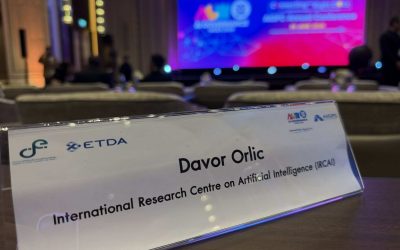
“This consultation must be genuinely global. We invite AI companies not only from the United States, but from Europe, Africa, Asia, Latin America and the Caribbean, the Arab States and all regions of the world to join the research community and contribute their experience and perspectives,” said Davor Orlic, Chief Operating Officer of IRCAI. “Companies are not only important participants in identifying the research questions that need to be answered; they can also help translate the findings into practice. We therefore want industry to engage with the Research Agenda, challenge it, contribute to it and, ultimately, implement the knowledge that emerges from it in the design and development of their products and services. Ethical by Design AI can only succeed if research and innovation move forward together.”
The consultation is sponsored by John Shawe-Taylor, Director of IRCAI and UNESCO Chair on AI at UCL; Vanessa Nurock, UNESCO Chair Ethics of the Living and Artificial at the University Côte d’Azur; Wayne Holmes, UNESCO Chair on the Ethics of AI and Education at IRCAI and Professor at UCL; Emma Ruttkamp-Bloem, UNESCO Chair on AI for Community Resilience at the University of Pretoria and Senior Fellow at the African Institute for Data Science and AI; Davor Orlic, COO at IRCAI, and João Pita-Costa, head of AI research at IRCAI.
About IRCAI
The International Research Centre on Artificial Intelligence (IRCAI) under the auspices of UNESCO, based at the Jožef Stefan Institute in Ljubljana, Slovenia, works internationally at the intersection of artificial intelligence, research, sustainable development and responsible innovation.
Media contact:
International Research Centre on Artificial Intelligence (IRCAI)
Jožef Stefan Institute
Ljubljana, Slovenia
info@ircai.org
www.ircai.org